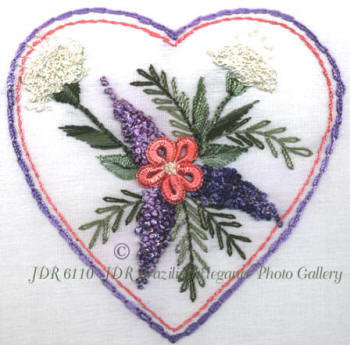
Designed by Dexie Smith for JDR-BE Graphics and Directions by
Sunshine
Stitching Area: 5.5” x 5.5
Registration Marks: 8” x 8”
Fabric: 12” x 12
A Quilt Block can be cut perfectly from the 8” square up to the 12” fabric
cut size.
Directions for all the design elements are included.
A stitch review is provided
for the following stitches.
If you have the basic knowledge of Lazy Daisy,
blanket stitches, bullions, French knots, stem stitches and alternating satin
stitch, very simple detached buttonhole stitch, turkey stitches and chain
stitches this design will be very easy.
If you are just starting in your
adventure with Brazilian Embroidery this will be a great learning design.
The Milkweed Plant:
You’ll find this plant in fields, meadows, and along roadsides. If you find
milkweed, you’re also likely to find monarch butterflies. Meadows of Milkweed
plants attract hundreds of monarch butterflies. Milkweed is essential for
the existence of Monarch butterflies. You may want to stitch a butterfly
sitting on your flower tops. Where does the milkweed plant get its name?
It leaks a thick, white sap when cut or broken that makes it look like it’s
leaking milk. It grows from 2-6 feet high. It usually has a single, simple stem.
Flowers: Blooms from late June to August. Flowers emerge in umbrella-like
clusters and range in color from pink to rose-purple to orange or white.
Fruit: in the fall, flowers develop into seedpods. The pods have a warty outer
skin filled with downy fluff that will carry the seeds on the wind like a
parachute.
Pioneers used sap from milkweed as a cure for warts.
The airborne fluffy parachute of the seed was used by Native Americans to
insulate moccasins.
The dried empty seedpods were used as Christmas tree decorations by early
pioneers.
All JDR patterns & designs are copyrighted for JDR Brazilian Elegance. The
design
s presented for any other designer on our web site are also copyrighted by
the individual designer. No part of this material/website may be
reproduced in any form, in whole or in part, by any means-mechanical,
electronic, graphic, downloading, photocopying, photographing, tracing or means
yet to be discovered without written permission.
Prices are subject to change with out notice










 Add JDR JDR 6110TP $20.10 (14 Skeins)